
619 Nicola Street
Description of Historic Place
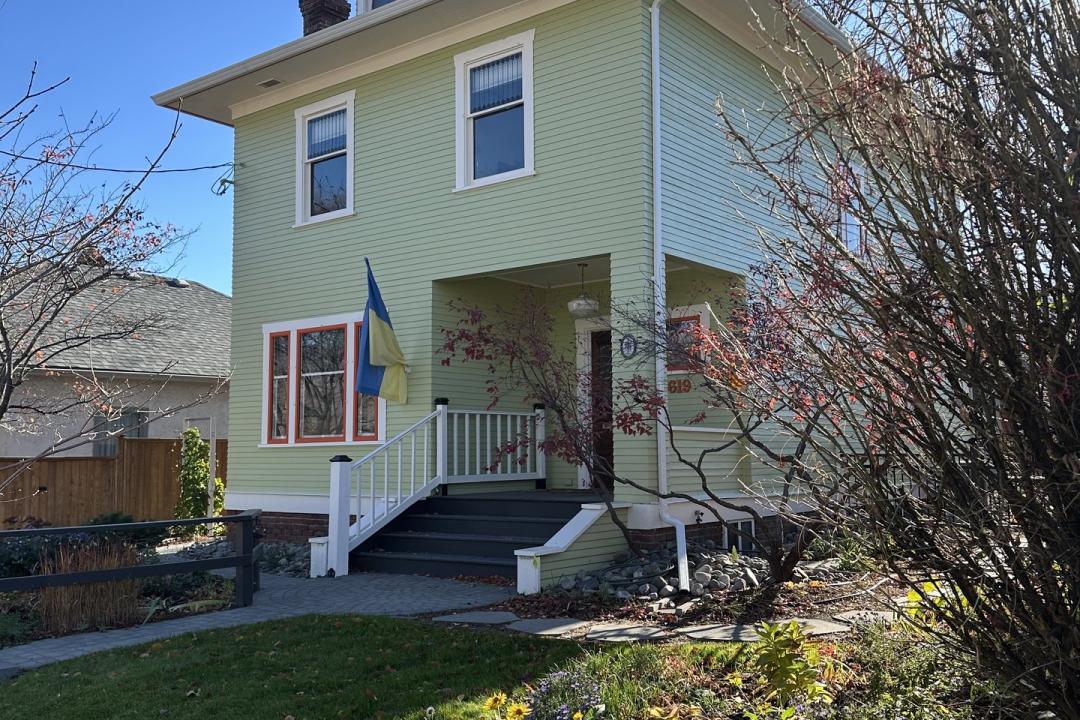
The William W. Bishop House is located on a gently terraced site, in an urban residential neighbourhood on Nicola Street, south of the downtown core. A typical Edwardian Foursquare in style and detailing, the house is distinguished by its broad hipped roof, inset corner porch and leaded coloured glass windows.

Heritage Value
The William W. Bishop House, built in 1913, is a significant example of a finely crafted Edwardian-era Foursquare that illustrates the strong economy in Kamloops at the very end of the boom years of the early 1900s. Spurred by the natural resource and economic boom in British Columbia, and linked to the Canadian Pacific Railway, this was a fertile location for the establishment of numerous agricultural, mining, lumber and ranching industries. Kamloops experienced unprecedented growth, speculative real estate deals and the arrival of large numbers of homesteaders into the area. A downturn in the economy at the time of World War One, magnified by labour unrest during the building of the Canadian National Railway, ended this period of economic growth.
Additionally, the William W. Bishop House is valued for its association with Kamloops's colourful and politically charged newspaper industry. The house was built for William Wills Bishop (1874-1940), a printer for The Standard; a newspaper started in 1897 by future mayor of Kamloops, John T. Robinson, and C. Wentworth Sarel, both Conservatives. The Standard ran in political opposition to Inland Sentinel, and bought it out in 1914. Bishop worked at The Standard until 1921, after which he and his wife, Elizabeth Davidson Bishop (née Gray, 1878-1955) sold and moved to Salmon Arm. Other owners associated with the house were Sarah and Louise Holt, who remained in the house until their deaths. Their niece, Kay Bingham, lived in the house and inherited it after her aunts died; she was a well-known and beloved teacher in Kamloops who had a school named after her in 1967.
The William W. Bishop House is further valued as an elegant and notably intact example of Edwardian-era architecture, designed as a rational expression of modern needs and conveniences. Typical of the housing stock built for the burgeoning middle class, it imparts an overall sense of formality. The pervasive influence of the Arts and Crafts movement signalled loyalty to Britain and traditional values, and is evident in the original design and detailing.
Character-Defining Elements
Key elements that define the heritage character of the William W. Bishop House include its:
- location in a residential neighbourhood of contemporaneous houses, south of downtown Kamloops on Nicola Street
- minimal set-back from the street, on a terraced lot
- residential form, scale and cubic massing as expressed by its two-storey height with a broad hipped roof, wide closed eaves, central hipped roof dormer and inset corner porch
- Foursquare style as reflected in its stringent symmetry, and corner inset front door
- wood-frame construction with narrow lapped wooden siding on the body of the house and the porch column
- additional external elements such as its red-brick foundation and external corbelled red-brick chimney
- regular fenestration, including 1-over-1 double-hung wooden-sash windows in single and triple assembly, with diamond-paned leaded coloured glass in the upper sash
- associated landscape features such as mature deciduous trees at front and side of property